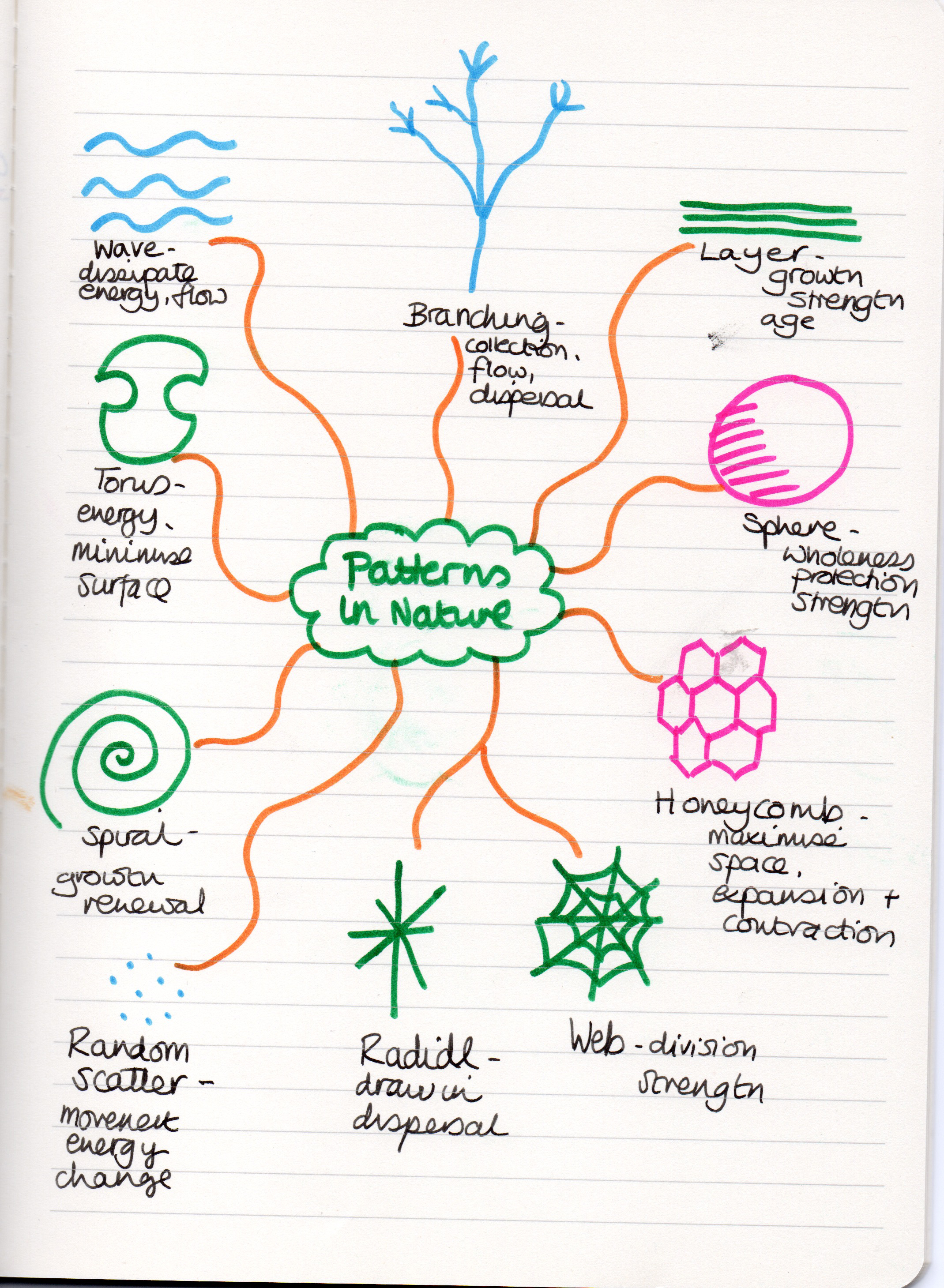
Permaculture Design is about looking to nature, and associated indigenous wisdom, to take inspiration and to create all manner of things that serve as regenerative solutions for ourselves, our communities and our planet.
One of the simplest ways to do this is to look for patterns in the natural world, to think about the function of these patterns, then to reflect upon what we can learn from them and how we may bring this natural wisdom into our own projects, work and lives.
What can we learn from the spherical security of a seed?
From the dynamic and transformational energy of a torus in a tree?
From the dispersal and flow of water facilitated by branching patterns in river estuaries?
Or from the spiral of growth and renewal that the passing seasons bring with them year after year?
But what if patterns in nature don’t actually exist? Clearly the different physical forms are there for all to see, but is it fair to say that nature creates patterns?
Maybe a more accurate understanding of these “patterns” is as a continuous process of creation of the most functional and efficient form for any given moment in time and space. On this basis the patterns are actually the things that we as humans look for to better understand the complexity of the world around us. The patterns are the stories that we create in order to find meaning and connection – a kind of spatial folklore that allows us to begin to fathom our tiny place within this world of almost infinite diversity.
These pattern stories are nods of familiarity that echo and chime wherever we find ourselves, and that help us navigate our way through the world. They are consistent to us in their closeness to our sphere of knowledge to comfort, whilst also only ever being one step away from chaotic and radical change.
The seed shell breaks and a radicle emerges.
A storm comes and the great tree falls in the forest.
The river moves the grit and stone of the earth itself and over time its course changes.
Bit by bit the climate warms and our seasons no longer arrive in a familiar form.
The patterns are still the same but simultaneously they are also different. So perhaps the most significant thing that we can learn from them in a rapidly changing world is how we, as part of nature, can react continually to the immediacy of our situation. And how we can let ourselves behave as the organic beings that we truly are in a constant process of discovering our own unique function and form.
 Liz Postlethwaite